Why Agricultural Drone Solutions Are Reshaping UK Farms
A Different Way of Looking at the Field
There is a moment in late spring when the oilseed rape starts to yellow and you realise the season has turned. For many growers, that is also the moment they notice the patches in the field where the crop never really got going. The tramlines look fine from the cab, but from above the story changes. That is where agricultural drone solutions have started to make their mark, not as a futuristic gimmick but as a practical tool for seeing and acting on what is actually happening across the farm.
The shift has been gradual, then sudden. A few years ago drones were something you saw at a demo day or heard about from a neighbour who likes new kit. Now they are part of the conversation at the National Farmers' Union meetings and in agronomy notes. The reason is simple: they save time, they save inputs, and they give you data that used to require a satellite pass or a lot of walking.
From Scouting to Spraying: What the Technology Actually Does
Start with the eyes. A drone fitted with a multispectral camera can capture NDVI imagery that shows crop vigour in remarkable detail. You can spot nitrogen deficiency, water stress, or disease pressure before it becomes visible from the ground. That is not a vague promise; it is a practical way to target your crop scouting and spend your walking time where it matters. Instead of trudging through every field, you check the maps and head straight to the problem areas.
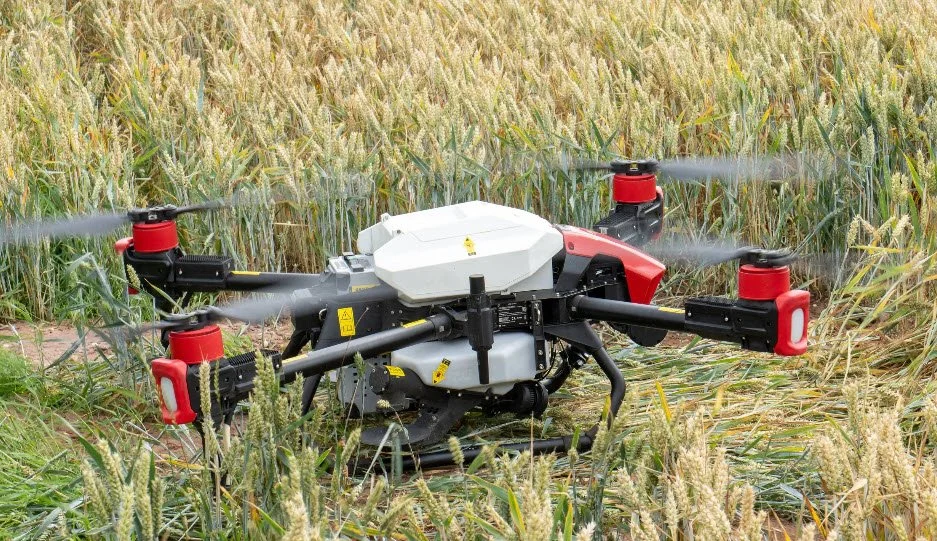
But the technology has moved well beyond observation. The same platforms that carry cameras can now carry spreaders and sprayers. DJI Agras models, for instance, are designed specifically for agricultural work, with tanks and pumps that turn a quadcopter into a flying applicator. XAG has pushed the autonomy side, with systems that can map a field and then return to spray or spread without constant input. Yamaha Motor has been in this space for decades, mostly with larger helicopters, but the principle is the same: precise application from the air.
What makes these systems useful is not just the hardware. It is the way they fit into a wider system of precision agriculture. RTK GPS gives centimetre-level accuracy, so the drone knows exactly where it is and where it has been. That means variable rate application becomes practical, not just on big arable farms but on smaller units too. You can vary the rate of fertiliser or crop protection products within a single field, matching what the crop needs rather than applying a blanket rate.
The Practical Reality of Spreading and Spraying
There is a tendency to talk about drones as if they will replace every tractor and sprayer tomorrow. That is not how it works, and anyone who has spent a wet autumn on the headland knows why. Ground machines still have a place, especially for heavy work and large acreages. But drones fill a gap that ground equipment cannot always reach.
Consider slug control in oilseed rape. The window is tight, the crop is small, and the ground is often too wet for a sprayer without causing damage. A drone can fly in, apply the pellets or the spray, and be gone before the wheels would have made the first pass. Same with late season top dressing on a crop that has canopied over. The drone does not crush the crop, does not leave wheelings, and does not make you wait for a dry day.
Seeding is another area where drone work has surprised people. On difficult terrain, or where you want to overseed a cover crop without disturbing the soil, a drone can drop seed with surprising accuracy. It is not going to replace the drill on a thousand acre block, but for targeted work it is hard to beat. The same applies to broadcasting small seeds into an established sward.
All of this comes with a learning curve. The CAA regulates commercial drone use in the UK, and you need the right permissions and training. That is not a barrier so much as a reality check. Anyone thinking about buying a drone for farm work should factor in the paperwork, the insurance, and the time it takes to become competent. The good news is that the industry has matured, and there are now operators and agronomists who can help you get started.
Making the Numbers Work on Your Farm
The question every farmer asks is whether the kit pays for itself. The honest answer is that it depends. On a large arable enterprise, the savings from variable rate application can add up quickly. If you are applying less fertiliser on the parts of the field that do not need it, and more where the crop is hungry, the input bill drops and the yield map improves. The same logic applies to crop protection: spot spraying weeds rather than treating the whole field can cut chemical use significantly.
There is also the labour angle. Drone Ag, a company that has built a business around this technology, points out that a single operator can cover a lot of ground in a day. That matters when labour is hard to find and even harder to retain. A drone does not need a tea break, and it does not mind working late in the evening when the wind drops.
But there are trade-offs. Battery life is still a constraint, and you need to plan your work around charging times. Payload capacity is limited compared to a tractor, so you are not going to spread a tonne of fertiliser in one flight. And the weather matters. High winds and rain can ground a drone just when you need it most. The best approach is to use agricultural drone solutions as part of a broader toolkit, not as a silver bullet.
What the Experts Are Saying
Agronomists are increasingly seeing drones as an extension of their own eyes. One adviser I spoke to described using a drone to check the accuracy of a variable rate nitrogen plan. The NDVI maps confirmed where the crop was behind, and the drone's spreading capability allowed a quick top up without waiting for the contractor. That kind of responsiveness is new, and it changes the relationship between the adviser and the grower.
The National Farmers' Union has been supportive of the technology, while also pushing for clear rules and fair access to airspace. The CAA has responded with a framework that allows commercial operations under certain conditions. It is not perfect, but it is workable, and it is far ahead of many countries.
SenseFly and Parrot are names you hear less often in the spraying context, but they have been important in the mapping side. Their fixed wing drones can cover large areas quickly, producing the high resolution imagery that makes precision agriculture possible. That data feeds into the same decision making process that drives the spreading and spraying.
Getting Started Without Getting Burned
If you are thinking about bringing drones onto your farm, start with the mapping. You do not need to buy a sprayer first. Get a small drone, learn to fly it legally, and use it to scout your crops. The insights will surprise you, and they will help you decide whether the application side is worth the investment.
When you are ready to move into spreading and spraying, look at the options from DJI Agras or XAG. They have proven themselves in the field, and there is a growing network of dealers and operators in the UK who can offer advice and support. Do not be afraid to hire a contractor first. Many growers are now using drone services on an ad hoc basis, which lets them see the benefits without the capital outlay.
One thing to keep in mind is the regulatory side. You need permission from the CAA for commercial work, and you need to be aware of airspace restrictions and data protection rules. It is not as daunting as it sounds, but it is not something to ignore either. A good training provider will walk you through it.
The Bottom Line for UK Agriculture
UK Agriculture is under pressure to produce more with less, and to do it in a way that is kinder to the environment. Drones will not solve every problem, but they are a genuine tool for reducing inputs, improving accuracy, and saving time. The technology is mature enough to be practical, and the cost is coming down every year.
The farms that get the most out of this are the ones that treat it as part of a system, not a standalone gadget. Combine drone imagery with soil sampling, yield data, and good agronomy, and you have a powerful decision making toolkit. Add the ability to act on that data with precise spreading and spraying, and you start to see why so many growers are paying attention.
There is a learning curve, and there are days when the wind will not cooperate. But the direction of travel is clear. Agricultural drone solutions are here to stay, and they are becoming a normal part of how modern farms operate. Whether you are a thousand acre arable farmer or a mixed enterprise with a few fields, it is worth taking a closer look.